Why reposted and duplicate content gets suppressed — and what "technically distinct" means
Posting one file to five accounts used to be free reach. In 2026 it's the fastest way to get four of them ignored. Here's what the platforms actually detect, what they've said about it, and the difference between a copy and a variant.
Checked against the platforms' own announcements and help pages in August 2026. This area moved a lot in the last two years; dates are given where it matters.
What the platforms have said
- Instagram announced in 2025 that it would limit the reach of accounts repeatedly posting content they didn't create, add labels pointing to the original, and replace a detected repost with the original in recommendations. On 30 April 2026 it extended the rule beyond Reels to photos and carousels and said the quiet part out loud: an account whose posts are mostly someone else's content is no longer recommendable. Eligibility is assessed over a rolling month; superficial edits — watermarks, borders, speed changes, crediting — explicitly don't count as originality. Followers still see the posts; Explore, Reels and suggestion surfaces don't.
- TikTok lists "unoriginal" and low-quality content among the categories it may make ineligible for the For You feed in its published eligibility standards, and shows the status per video in analytics.
- YouTube has policed "reused content" at the channel level for years through its monetization policies, and limits recommendation of repetitive, mass-produced uploads.
The common thread is that the target is sameness — whether it's someone else's file or your own file five times.
What gets detected
Nobody publishes their detector, but the platforms' wording and a few years of operator experience agree on the inputs:
- The file. Perceptual fingerprints of the video frames and the audio track. Re-encoding, a new filename, a slightly different bitrate — none of that changes a perceptual fingerprint. This is the same technology that matches music for copyright.
- The look. Another platform's watermark, a username overlay from elsewhere, the letterboxing of a screen recording.
- The text. Identical captions, titles and first comments across posts and accounts.
- The pattern. The same file appearing on several accounts within minutes, accounts that only ever post things that already exist on the platform, accounts that mirror each other post for post.
Point 1 is why "just re-export it" does nothing. Point 4 is why this hits multi-account operators hardest even when every clip is their own.
What "technically distinct" means — and doesn't
VidVertex describes its randomizer as keeping every upload technically distinct. It's worth being precise about that phrase, because the difference between honest and dishonest is exactly here.
Technically distinct means: when one clip is rendered for several brands and platforms, the outputs are not byte-identical and not frame-identical copies — each variant has its own crop and zoom, a slightly different color balance, its own frame rate, its own metadata and filename, and whatever audio treatment you've switched on. Every tweak is an individual toggle (the settings), and the point is that ten pages don't publish ten copies of one file.
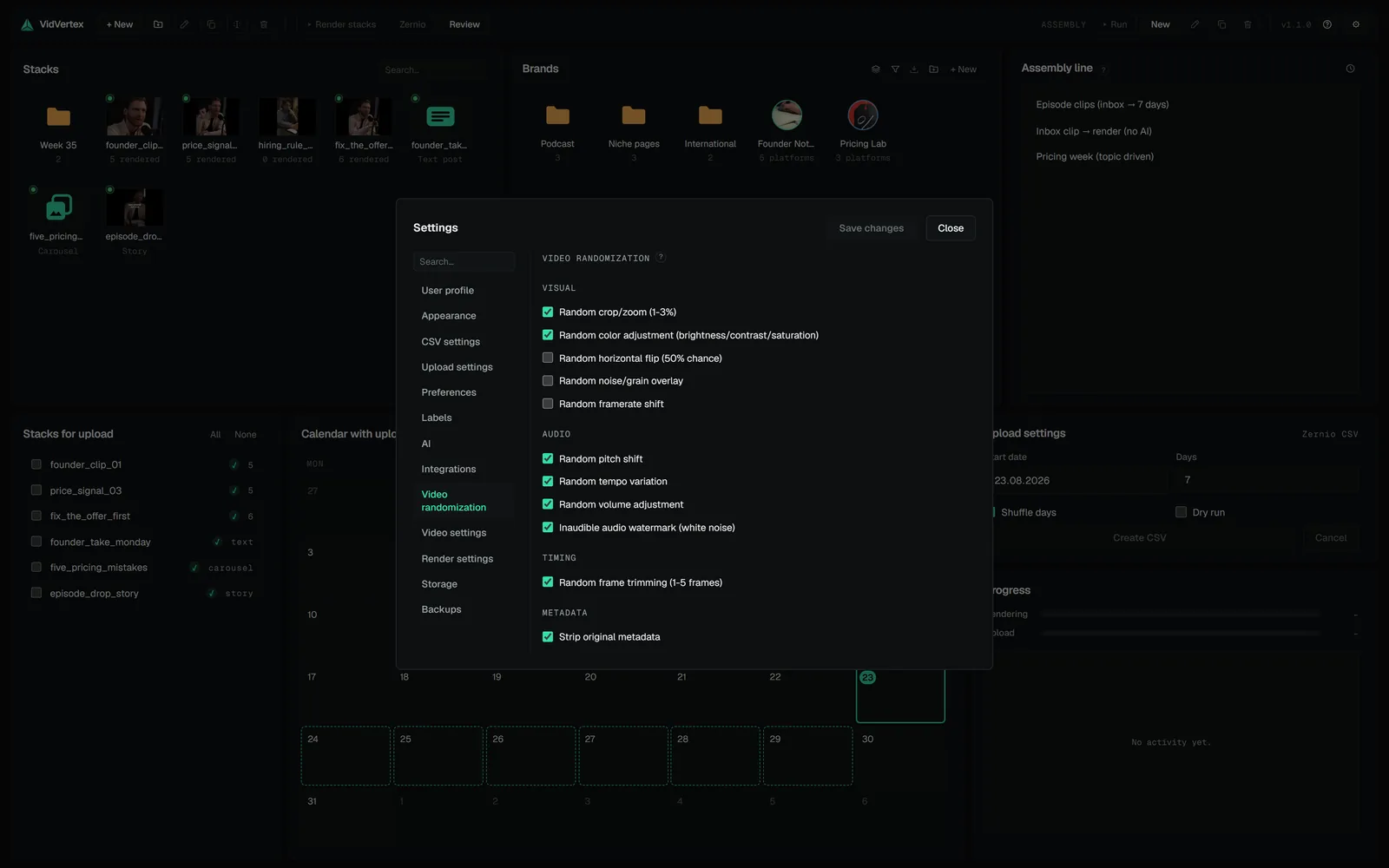
What it does not mean — and what we won't claim — is that the platforms can no longer tell. Their stated target is unoriginal content, not identical files; an account that posts other people's work with a 2 % zoom is exactly what Instagram's April 2026 rule describes as "superficial edits". The randomizer removes the cheapest, most mechanical signal of sameness. It does not make a repost original.
Copies vs. variants
The useful distinction is what a viewer of both accounts would say:
- A copy is the same post twice. Same cut, same hook, same captions, same look. Even if the file differs, the viewer shrugs, and so does the ranking system over time.
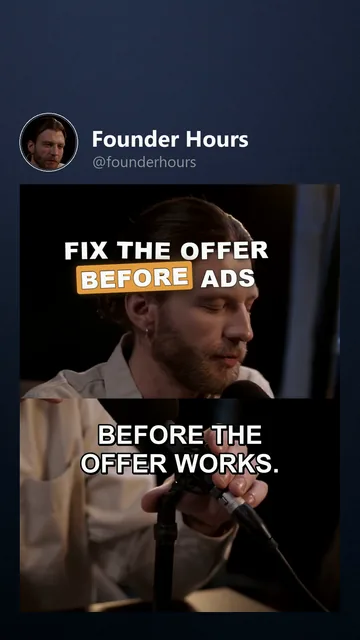
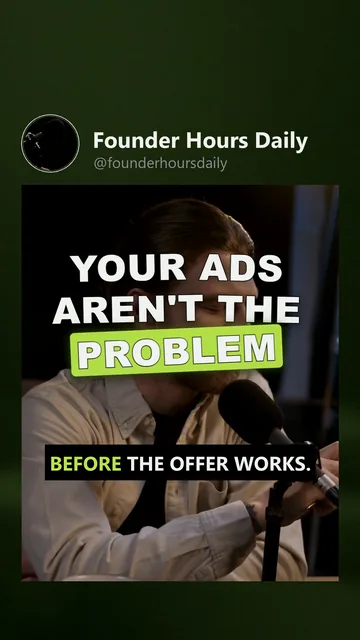
- A variant is the same source material made into a different post: another opening moment, a different hook line, the brand's own caption style and colors, different overlays and background, a different length, the brand's voice in the title and description — sometimes another language entirely. Two viewers following two of your pages see two posts that each belong where they are.
 Click to enlarge
 Click to enlarge
 Click to enlarge
That's the model VidVertex is built around: one stack, one render per brand and platform, each pulling from that brand's own pools, hook angles, caption look and texts (how variants are produced). The randomizer is the last, smallest layer on top. If you're doing this by hand, the order of value is the same: change the post first, the file last.
Your own content on your own pages
Reposting your own video to your own second account is not a rights issue and not against any rule. It's a reach issue, for the reasons above: the platform has seen the file, the second upload tests poorly or not at all, and over months the second account learns a reputation for posting things that already exist. The fix is the variant approach, not secrecy.
Posting the same clip to TikTok, Shorts and Reels is fine and normal — different platforms, different audiences (cross-posting). The problem is mirrors within one platform.
Other people's content
If the footage isn't yours, the question before any of this is whether you're allowed to post it, and the honest answer in 2026 is that aggregator pages are the exact thing the April rule was written against. Clipping with permission, commentary that transforms, licensed material — fine, and the variant logic above applies. "Credit in caption" is not permission and, per Instagram's own wording, not originality either.
A short checklist
- Would a viewer of both pages call these the same post? Then they are.
- Does the file carry another app's watermark or username? Remove the source, not the mark.
- Are captions and first comments identical across pages? Write per page — VidVertex generates them per brand and language so this isn't a chore (AI text per brand), but a spreadsheet works too.
- Are five pages posting within the same minute? Stagger (posting time per brand).
- Is the page mostly reposts over the last month? Then the page, not the post, is the problem.
 START HERE · 3 MINCross-posting right: what actually differs between platforms"Just post it everywhere" is correct — and still done wrong most of the time. The differences that matter aren't the ones people obsess over.
 ACCOUNTS & GROWTH · 3 MINWhat the platforms actually allowMost account disasters aren't bad luck — they're a rule the operator never read. Here's the map of what short-form platforms permit, tolerate and punish.TROUBLESHOOTING · 5 MINExactly 0 views: what that means and how to find the causeA video with 40 views was shown and ignored. A video with 0 views was never shown at all — and the platform usually knows why. Here's the list of reasons, most likely first, and where each one leaves a trace.