Faceless pages as a portfolio business
No face, no personality, no camera — theme pages are content businesses run like portfolios: many small bets, systematic production, and layers of monetization on top.
 Click to enlarge
A faceless page sells a feed, not a person: motivation quotes, finance snippets, gym content, history facts, satisfying loops. Because no one's identity is attached, the operator thinks in portfolio terms — pages are assets you start, grow, monetize, sometimes sell, occasionally kill.
Why this model attracts operators
- It scales past one person's charisma. The formula, not the creator, is the product — so it can be systematized, repeated, even delegated.
- Small bets, real data. A new page is cheap to test (validation method); the ones that catch get the investment.
- Multiplication economics. The same production system runs page #2 at a fraction of page #1's setup cost — the whole game is making additional pages nearly free to operate. (Mechanically this is one stack rendered per brand × platform; the creators use case shows the tooling version.)
 Click to enlarge
The monetization stack
Faceless pages rarely live on one income stream — they stack them as the page matures:
- Platform payouts — the floor: enrolled programs paying for qualified original views (payout mechanics). Mind the originality rules — transformation is what makes compilation-style content payable.
- Affiliate links in bio — niche pages convert: gym page → supplements and gear, finance page → tools and books (affiliate playbook).
- Shoutouts & promo slots — once a page has an audience, its reach is a product other accounts and brands buy (selling shoutouts).
- Funnel to owned offers — the endgame: your page's traffic pointed at your own product, newsletter or community (views to product).
- Selling the page — documented posting history, clean monetization and multi-platform presence are what buyers pay for.
Grown pages do change hands, but treat a possible sale as a reason to run things cleanly rather than as the plan itself — the marketplaces are informal and prices vary wildly.
The operating system
What separates operators from hobbyists is boring: logistics.
- Source material pipeline. The #1 constraint. Where does license-safe material come for each page, weekly, forever? Own footage, licensed packs, public-domain material, original text/visual formats — decide per page before it launches, not when the well runs dry.
- Per-page identity as configuration. Each page's look — logo, colors, caption style, hashtags — defined once, applied automatically to every render. Ten pages must not mean ten manual styling passes.
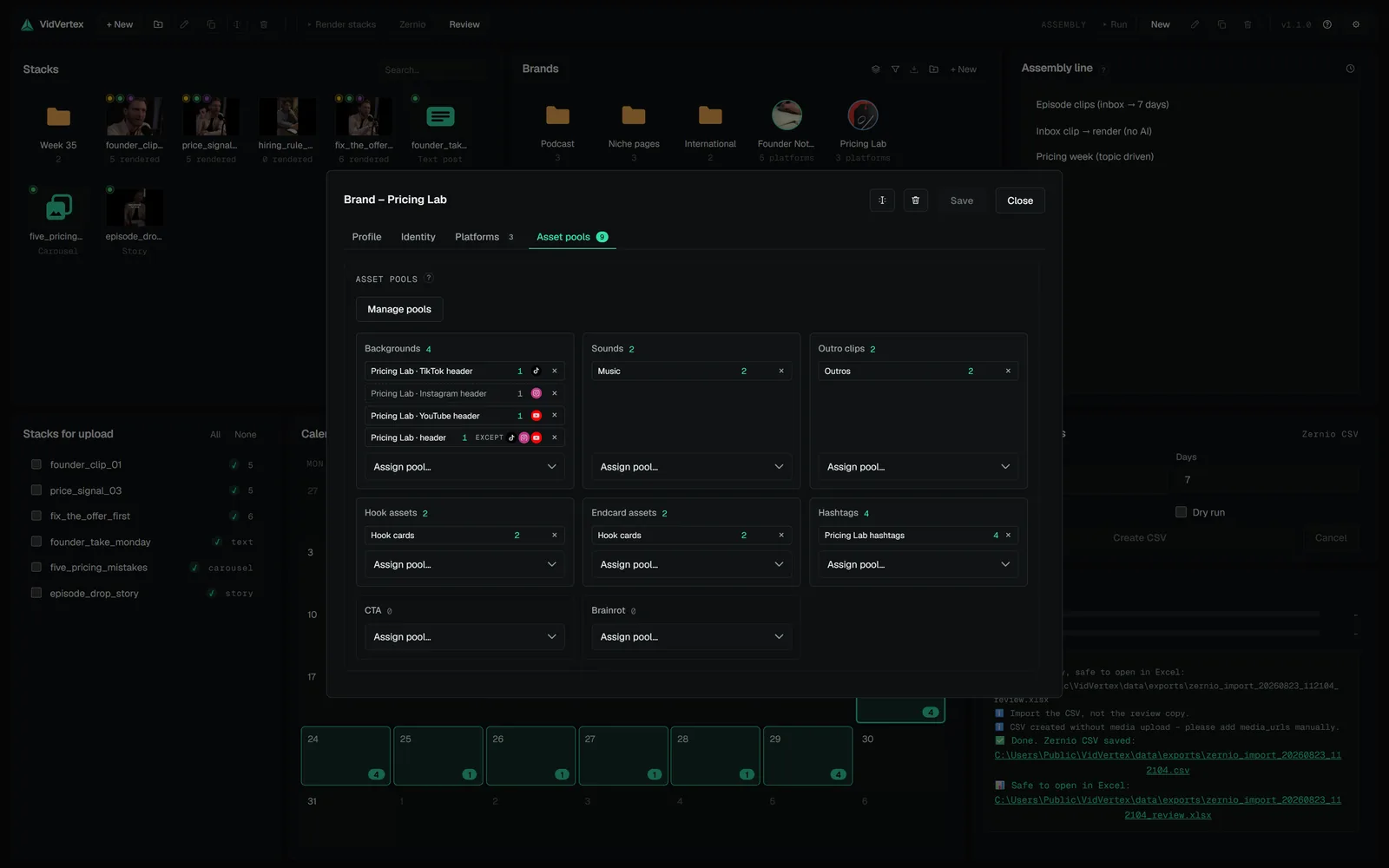
- Distinct output across the network. Vary the packaging per page — different hooks, cuts and styles, technically distinct files (why).
- One calendar for everything. Portfolio operation means a single view of what posts where and when — scheduled weeks ahead, per page, per platform (cadence).
- A kill rule. Decide in advance what a dead page looks like (e.g. no signal after N honest weeks) and actually kill them. Portfolio discipline is what makes the model work — zombie pages eat production capacity that winners deserve.
Identical files re-uploaded across your own pages are the single easiest way to make a network trivially identifiable — and they underperform on top of it. This is the rule portfolios break first, usually because it is the one that saves the most time.
Honest risks
Platform dependence is the big one: policy changes, payout changes and account enforcement hit portfolios harder than personalities (a person can rebuild; a network is its accounts). Diversify platforms early, keep source material rights clean, follow each platform's rules on multiple accounts and reposting — and route the winners toward owned assets (list, community, product) so the portfolio owns something no feed can take away.