Clipping as a service: getting your first client
Podcasters and streamers know they should post clips daily. They don't, because it's work. That gap is a service business.
Clipping is the most accessible content business there is: the skill (spotting and cutting good moments) is learnable, the demand is visible (every long-form creator with a dead clips channel), and the deliverable is concrete (N clips per week, posted). No audience of your own required.
What you're actually selling
Not editing. Presence. The client outcome is "my short-form runs without me": moments found, clips cut, captions styled, branding on, posted on schedule, across platforms. The cutting is maybe a third of that work — the packaging and distribution grind is the part clients happily pay to never think about (the clippers use case breaks down how the production side collapses with batch tooling; it's how one person serves several clients).
 Click to enlarge
 Click to enlarge
Getting client #1
The clipping market runs on proof, not pitches:
- Pick a target you actually watch. Your clip instincts are only good in content you understand. List 5–10 podcasters/streamers in that space with real long-form output and weak/no clips presence — mid-sized is the sweet spot (big enough to care, small enough to answer DMs).
- Make the spec work first. Take their latest episode, cut 3 clips, caption and brand them properly. Send the finished clips, free, no strings: "made these from Tuesday's episode — use them freely; if you want this weekly, that's what I do." A finished clip in their hands beats any portfolio link — and 30 minutes of spec work filters you above everyone who just commented "DM for clips".
- Offer a paid trial month. Low friction both ways: fixed clip count, fixed price, cancel anytime. Your goal in month one is a habit — their feed was dead, now it's alive. That contrast is your renewal pitch.
Pricing sanely
Three standard shapes, in ascending order of maturity:
| Shape | What it covers | Why it sits there |
|---|---|---|
| Per clip | One clip, one price | Simplest to start, caps your upside, fine for trials |
| Monthly retainer | N clips a week, cut, branded, captioned and scheduled | The standard. Price against the hours they'd spend — your tooling advantage is your margin, not their discount |
| Retainer + distribution tier | The baseline, plus posting natively on every platform with per-platform captions and a calendar report | Distribution costs you minutes once automated (scheduling docs) and is exactly what clients can't be bothered to do — the best-margin line on the invoice |
Charge real money from client #2. Spec work is marketing; ongoing cheap work is just a bad job.
Delivering without drowning
The failure mode of clipping businesses is success: five clients × five clips × four platforms = a hundred weekly deliverables. Survive it with systems from day one:
- One intake ritual: episodes land in one place; you mark moments on first listen (repurposing workflow).
- Per-client branding as configuration, not per-clip work: logo, colors, caption style, hashtags set up once per client and applied automatically — the "client = brand" pattern.
- Batch days, not daily scrambles: cut everything in one sitting, caption and schedule in another (cadence guide).
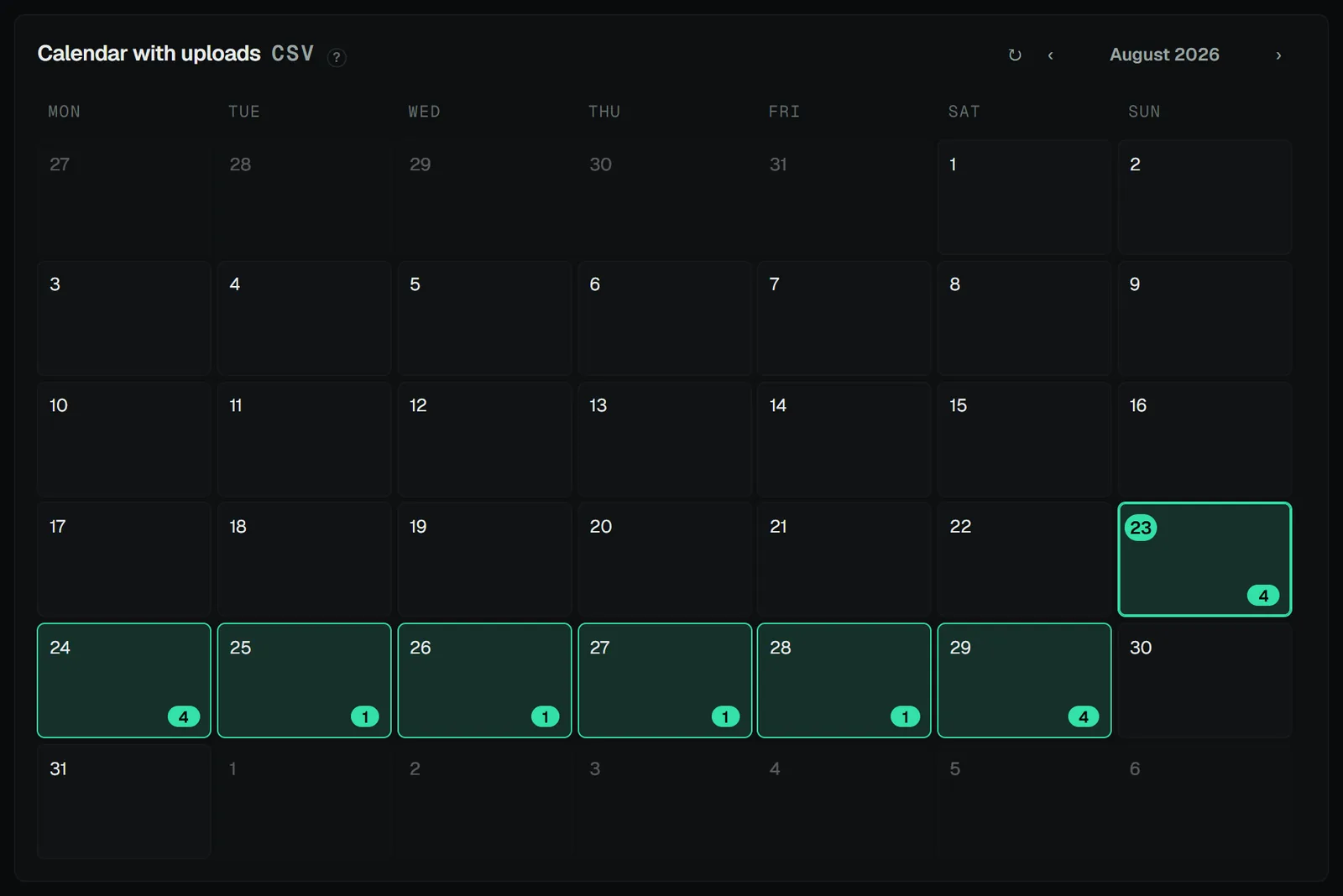
- Weekly proof: a screenshot of the filled calendar with the invoice. Clients renew what they can see.
Growing past yourself
The ceiling is your cutting hours — everything after the cut should already be automated. From there: raise prices (fastest), narrow to a niche where your clips demonstrably perform (specialists out-earn generalists), or hire cutters and keep packaging/distribution centralized — at which point you're an agency, in the honest sense: systems serving a roster, not heroics serving deadlines.