A/B-testing hooks across accounts
One video can't tell you whether the hook worked — too much noise, one test group. Several pages can. Here's how multi-account operators turn their roster into a testing rig for openings, without tripping the duplicate rules, and how to read the result.
Platform behavior referenced here was checked against the platforms' own help pages in August 2026.
The opening line is the single most testable thing in short-form: it's a few words, it decides the first-second skip, and the feeds report its effect directly as retention in the first seconds (hooks). The problem is statistics.
One video on one page is one sample from one test group. You can't learn much from it — and re-uploading the same clip with a different hook on the same page is a repost (reposting your own content).
Why several pages solve it
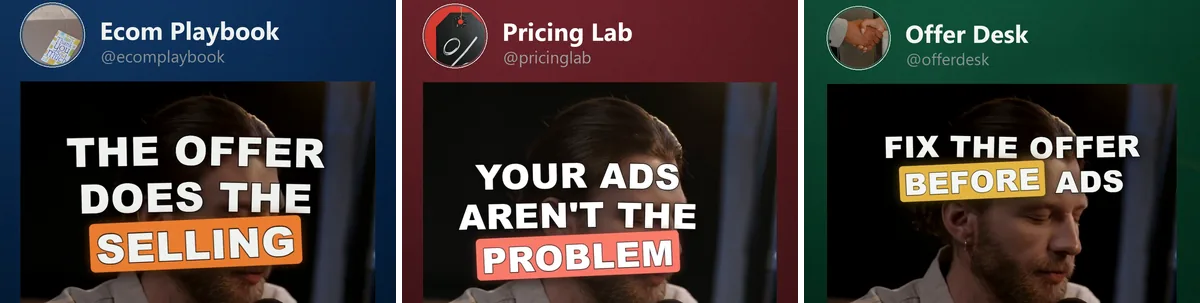
If you run more than one page in a niche — your own theme pages, a roster of client pages, language variants — each page is an independent audience and an independent first test. Render the same source clip as a different variant per page, each with a different hook line, and you've run a parallel test in one batch: same footage, same day, several openings, several test groups.
 Click to enlarge
That's honest testing, and it's also what the originality rules want: each page gets a genuinely different post — its own hook, caption style, overlays, texts — not a copy with one word changed (duplicate content).
Setting it up
- Write the hooks as angles, not variations of one line. "Stop scaling ads" vs. "The offer is the problem" vs. "Price is a signal" — three ways in, not three synonyms. Five to ten angles per clip is a good pool.
- One angle per page, or rotate. With a roster, each page gets one angle for this clip. With fewer pages, rotate angles across clips over the week. VidVertex keeps hook angles as a pool on the stack and rotates them per variant automatically — one stack, each brand's render opens with a different line, per language if the pages differ (hooks in the editor).
- Keep everything else constant. Same clip, same length, same caption structure, same posting time relative to each page's audience. The hook is the variable; the brand look is a constant per page, not a variable.
- Log which page got which angle. Pre-flight and the upload history show it in VidVertex; a spreadsheet column does it by hand.
Reading the result
Don't read views. Read, per page:
| What to read | What it tells you | Where it misleads |
|---|---|---|
| Retention at 2–3 seconds | The hook's own number | Meaningless across pages of different sizes |
| Completion rate | Whether the hook promised the right thing | A short clip flatters it |
| Follows and saves per view | Whether the hook brought the right people | Needs enough views to mean anything |
Then compare against that page's own baseline, not against the other pages. Page A at 40 % more three-second retention than its usual is a win even if Page B's absolute number is higher. Pages differ in audience size and warmth; the delta is the signal.
A hook "wins" when it beats its page's baseline on two or three clips, not one. Sample sizes are small; patience is the statistics.
What you learn, and how to use it
- Angles that win across pages go into the standard pool for that format — the opening that works regardless of audience.
- Angles that win on one page tell you something about that page's audience; keep them there.
- Angles that lose everywhere get cut, and usually reveal a pattern (too clever, too slow, a question nobody asked).
Feed the winners back into generation — the briefing that produces next week's hooks should know which angles worked (AI briefing).
Mistakes that ruin the test
- Changing two things at once. New hook and new length and new caption style — you learn nothing.
- Same page, same clip, different hook, same week. That's a repost, and the platform treats it as one.
- Reading one video. Three clips minimum before calling an angle.
- Mirror pages. If the pages are copies of each other, their audiences overlap and the "independent" test isn't. Distinct pages — different look, different texts, ideally different niches or languages — are what make the rig work (creator managers).
- Testing hooks on a page in a reduced state. Check the status pages first (platform messages); a restricted page's numbers measure the restriction, not the hook.
The roster is an asset most operators only use for reach. Used as a testing rig, it's the fastest way there is to find out what actually makes people stop scrolling — and it costs one render batch.