Hooks: the first two seconds
Most videos don't fail in the middle. They fail before they start — in the two seconds where a scrolling thumb decides whether you exist.
A hook is everything a viewer sees and hears before deciding to stay: the first frame, the first movement, the first words, the first text on screen. In a feed, that decision happens faster than conscious thought — you're not convincing anyone, you're interrupting a scroll reflex.
The good news: hooks are a craft, not a talent. They follow patterns, patterns can be written down, and written-down patterns can be tested.
What a hook has to do
Three jobs, in order:
- Interrupt — something on screen must break the visual rhythm of the feed: motion, a face, bold text, an unexpected image.
- Promise — in one beat, the viewer must know what staying gets them: a payoff, an answer, a transformation, a laugh.
- Open a loop — the promise must be incomplete. The gap between "I know what this is about" and "I don't know how it ends" is what carries someone past second three.
Hook patterns that keep working
Steal these shapes, fill in your niche:
- The direct promise: "Three settings that make your renders look professional." Plain, honest, effective — the workhorse.
- The curiosity gap: "Nobody talks about the real reason small accounts stay small." Opens a loop it doesn't close.
- POV / situation drop: "POV: your first client asks for 30 videos a week." Instantly casts the viewer in a scene.
- The contrarian take: "Posting daily is bad advice — here's what daily actually means." Friction creates attention; make sure you can back it up.
- The mid-action start: the video begins inside the interesting moment — no intro, no logo, no "hey guys." Context comes second.
- The stakes line: "I spent 30 days testing this so you don't have to." Effort invested = payoff implied.
- The visual pattern break: for faceless content — an unexpected first frame, a bold text card, a freeze on the most interesting frame of the clip.
Two anti-patterns to kill on sight: the slow intro ("hey guys, welcome back, today we're going to…") and the context dump (thirty seconds of backstory before the point). Both answer a question nobody asked yet.
| Pattern | What it does | Where it fails |
|---|---|---|
| Direct promise | States the payoff in one line | Weak when the payoff is small |
| Curiosity gap | Opens a loop it doesn't close | Reads as clickbait when the body doesn't deliver |
| POV / situation drop | Casts the viewer in a scene | Needs a scene the audience recognises |
| Contrarian take | Friction creates attention | Only if you can back it up |
| Mid-action start | Begins inside the moment | Needs a moment that reads without context |
Text hooks vs. spoken hooks
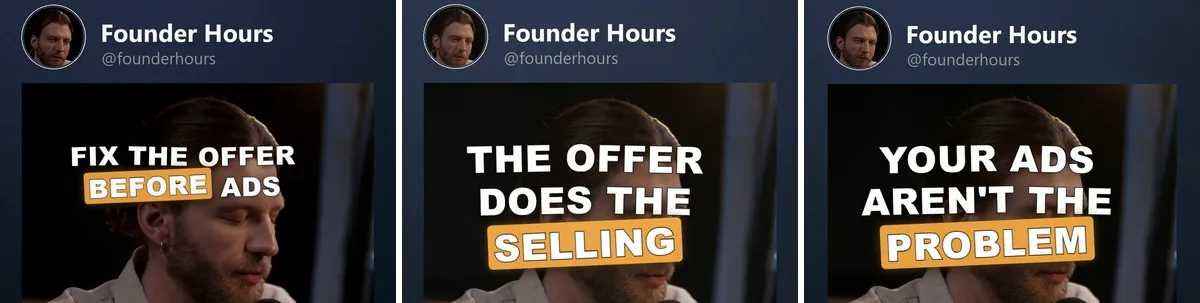
You usually want both — they do different jobs. The spoken opener carries viewers who watch with sound; the text hook carries the sound-off scrollers and adds a second, skimmable layer. They don't have to say the same thing: a text card can frame ("Day 12 of testing this") while the audio delivers.
If you produce at volume, write hooks as pools, not one-offs: ten angles for the same video, rotated across variants and accounts, tell you which framing pulls — the same clip can die with one hook and run with another. (This is exactly what VidVertex's hook rotation automates: a list of angles, one per variant, styled or animated or spoken. See the stack editor docs if you're curious.)
 Click to enlarge
Writing hooks in batches
Write the batch before you open the editor. Six hooks in five minutes is the exercise; picking the best two is the work.
A practical exercise that beats staring at a blank line:
- Take your video's payoff and write it as one plain sentence.
- Now write it as: a promise, a question, a POV, a contrarian claim, a numbered list, a stakes line. That's six hooks in five minutes.
- Cut every word that doesn't earn its place. Hooks die of fat.
- Read them out loud. If it sounds like writing, rewrite it like talking.
Judging hooks with data
The metric that judges a hook is early retention — where the audience-retention curve drops in the first seconds. A cliff at 0–2 s means the hook failed; a gentle slope means it did its job (whatever happens later is the body's fault). Platforms' creator analytics show this curve per video; read it before writing the next batch.
The hook is judged on a share, not on seconds. Losing half the viewers in the first two seconds caps every number that follows at half — no ending can win those viewers back.
Compare the curves of your best and worst video of a batch, not the views. Views tell you which draw you won; the curve tells you which hook to write next (reading analytics).
 START HERE · 3 MINHow short-form distribution actually worksForget "hacking the algorithm." Short-form feeds all run on the same simple loop — and once you see it, most growth advice explains itself.
 THE CRAFT · 3 MINWhy burned-in captions lift retentionA huge share of feed scrolling happens with the sound off. Captions aren't decoration — they're the sound-off version of your video.ACCOUNTS & GROWTH · 4 MINA/B-testing hooks across accountsOne video can't tell you whether the hook worked — too much noise, one test group. Several pages can. Here's how multi-account operators turn their roster into a testing rig for openings, without tripping the duplicate rules, and how to read the result.